Civil War Alcatraz History
For thousands of years before the Civil War, Alcatraz was a rugged rock inhabited by sea birds. Spanish explorer Lt. Juan Manuel de Ayala sailed into San Francisco Bay in 1775 and mapped prominent landmarks. He named one island "Isla de los Alcatraces" (Island of the Pelicans) because of their being so plentiful there." This name was shortened, anglicized, and attributed to what we call Alcatraz Island today.
Gold was discovered along the American River in 1848, and California was changed forever. The land formerly belonging to Spain and then to Mexico, was claimed as United States territory. As word of vast riches in California spread quickly, hundreds of ships filled with gold-seekers from around the globe arrived in San Francisco Bay. San Francisco's population exploded from 300 to 30,000 in just a few years. Suddenly San Francisco was the center of world attention.
The United States government needed to protect the land and its mineral resources from seizure by other countries. In 1850, California became a state, and President Fillmore issued an Executive Order reserving certain lands around San Francisco Bay for military use.
SAN FRANCISCO BAY FORTIFICATIONS
A "Triangle of Defense" was designed by Army engineers to guard the entrance of San Francisco Bay, with forts at Alcatraz Island, Fort Point, and Lime Point. The landowner of Lime Point and the government could never agree on a price, and that fort was never built. In 1853, construction began on Fortress Alcatraz, which was built atop the sandstone island, and Fort Point, a traditional casemate fort built at water level after massive excavation of the bluff. Alcatraz was completed first and became the most powerful of all Pacific Coast defenses. (map of SF Bay)
"Nature seems to have provided a redoubt for this purpose in the shape of Alcatrazes Island -- situated abreast the entrance directly in the middle of the inner harbor, it covers with its fire the whole of the interior space lying between Angel Island to the North, San Francisco to the South, and the outer batteries to the West....A vessel passing directly to San Francisco must pass within a mile." the Board of Engineers for the Pacific Coast , 1852
The rugged topography of Alcatraz was incorporated into the defense plan of the island. Blasting at the rock and laying brick and stone, laborers created steep walls around the island. Behind the walls, smooth-bore Columbiads were placed at the north, south, and west sides to provide gunfire at incoming enemy ships. Eventually 111 cannon almost encircled the island, and the gun batteries were named for prominent Civil War Union officers. North and south caponieres, masonry towers jutting out from the island midway between gun batteries, held smaller Howitzers to protect the sides of the island. Crowning the island near the lighthouse was a defensive barracks called the citadel.
The citadel was the final defense if the island was attacked. Constructed of sturdy brick walls with rifle-slit windows, the two upper stories provided living quarters, and the basement rooms were kitchens, dining halls, and storage of food, water and ammunition. Soldiers entered the citadel by crossing a drawbridge over a deep dry moat that surrounded the building. The citadel could hold 100 men during peace time and double that number under attack. By rationing provisions, troops could withstand a four month siege.
Due to the high walls, the island was accessible only from the dock. From the dock to the citadel, attackers had to get through the guardhouse. The guardhouse had Howitzers aimed toward the dock from each side room, and rifle slits for shooting enemies at close range. A dry moat and drawbridge, and heavy iron studded wooden doors blocked the road and prevented attackers from reaching the rest of the island.
Work progressed slowly on the fort. Finding laborers was difficult because newcomers to California were more interested in acquiring wealth through mining or establishing businesses rather than working for wages. Good quality building materials were hard to find. Many batches of brick were rejected before the citadel was built. Sandstone was quarried on nearby Angel Island, but much of the granite was imported from China.
By December 1859, the fort was ready. Captain Joseph Stewart and 86 men of Company H, Third U.S. Artillery took command of Alcatraz Island.
CIVIL WAR
The fort on Alcatraz took on a new role during the Civil War. As the rumblings of discontent on the East Coast erupted into gunfire in April 1861, Alcatraz defended the Union state of California from possible seizure by Confederates. California's population included both Union and Confederate supporters, and tensions ran high. Colonel Albert Sidney Johnston faithfully did his duty to calm the threat of war locally and protect San Francisco until he resigned his command. After returning to the South, Johnston accepted a commission in the Confederate Army and died at the battle of Shiloh.
Johnston's replacement immediately ordered all military forces around San Francisco Bay to be on full alert. With many new enlistees, the military personnel on Alcatraz increased to over 350 by the end of April 1861. New troops arrived, underwent training, and departed for other assignments, some to battlefields on the East Coast.
J.M. CHAPMAN
The first threat to California's security occurred in March 1863. San Francisco Police learned that a group of Confederate sympathizers were secretly outfitting a schooner to be a commerce raider at a dock in San Francisco. The plan was to arm the schooner, Chapman and use it to capture a large steamship which they would, in turn, outfit into larger raider to attack Federal commerce in the Pacific.
The
Confederate operation was thwarted when the hired pilot made mention of their plan in a tavern and, in due course, turned informant when confronted by San Francisco Police .
On the night the Chapman was to sail, the police and U.S. Navy personnel seized the ship and arrested the crew. The Chapman was towed to Alcatraz where an inspection revealed cannon, ammunition and supplies.
One of these men, a prominent San Franciscan, had papers signed by Confederate President Jefferson Davis appointing him an officer in the Confederate Navy.
The crew of approximately thirty individuals was confined in the Alcatraz Guardhouse, the captain, first officer and the informant being locked up in the solitary confinement cells on the first floor of the Citadel. They were ultimately charged with treason.
A quick series of trials and convictions produced sentences of up to ten years. However, it wasn't long before President Lincoln issued pardons and the entire crew was released upon taking an oath of allegiance to the United States.
The Unionists in San Francisco were shaken by the incident and feared that other Confederates were plotting in their midst.
H.M.S. SUTLEJ
In October 1863, an unidentified armed ship entered San Francisco Bay. Because there was no wind, the flag hung limp and men in rowboats towed the ship. The ship did not head toward the San Francisco docks. Instead, it traveled toward Angel Island to the North Bay, toward the army arsenal and the navy shipyard. The commanding officer at Alcatraz had a duty to ensure that no hostile foreign warship entered the bay.
Captain William Winder ordered the Alcatraz artillery to fire a blank charge as a signal for the ship to stop. The rowboats continued pulling the ship. Winder then ordered his men to fire an empty shell toward the bow of the ship, a challenge to submit to the local authority. The ship halted and responded with gunfire, which Winder confirmed was a 21-gun salute. Through the smoke, the Alcatraz troops could finally see the British flag waving on the H.M.S. Sutlej, flagship of Admiral John Kingcome. Alcatraz responded with a return salute.
Soon messages were exchanged rather than gunfire. As Commander-in-Chief of the British Navy in the Pacific, Kingcome wrote that he was displeased at his reception in San Francisco. Captain Winder explained his actions by saying, "The ship's direction was so unusual I deemed it my duty to bring her to and ascertain her character." The U.S. Commander of the Department of the Pacific supported Winder and replied that Kingcome had ignored the established procedures for entering a foreign port during war. Winder later received a letter of gentle reminder to act cautiously. Some San Franciscans thought Winder may have saved the day, considering that Great Britain favored the Confederacy.
BRADLEY AND RULOFSON PHOTOS
Capt. Winder found himself in an awkward situation the next summer when he authorized commercial photographers Bradley and Rulofson to take photos of Fortress Alcatraz. Prints of the 50 photos were to be sold to the public to offset the photographers' expenses. The War Department in Washington, D.C. did not commend Winder for his initiative and pride in his post, but rather questioned Winder's motives because his father was an officer in the Confederate Army. The Secretary of War ordered all the prints and negatives to be confiscated as a threat to national security. Later, Captain Winder humbly requested a transfer to Point San Jose, a small defense post on the mainland.
NEW FORTIFICATIONS
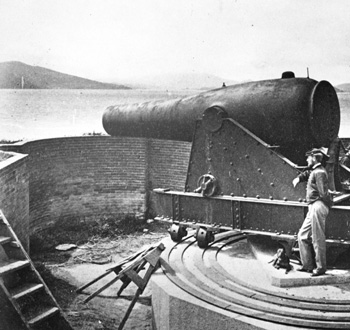
As the Civil War lingered on and the Union seemed likely to win, the U.S. Army was willing to devote more resources to the Pacific Coast. In 1854, the first 15-inch Rodman
cannons were mounted on Alcatraz. After the war ended, noted photographer Eadweard Muybridge was allowed to photograph neatly dressed military personnel posed around these mighty cannon. (photo)
Additional soldiers' quarters called a "bomb proof barracks" were approved. This two-tiered brick casemate building would hold 22 cannon to guard the dock. The upper tier would house 500 men, and the lower tier would hold four months of provisions. Excavation began in 1865, but because of lack of funds and obsolete design, only one tier of casemates was completed and the cannon were not mounted.
POST CIVIL WAR
The end of the Civil War in April 1865 marked the end of Alcatraz as an effective harbor defense. Although there were over one hundred cannon on the island, these smooth-bore cannon were obsolete. New rifled-bore artillery had a longer range, and were more accurate and powerful against masonry forts. As if signaling the end of an era, the Alcatraz gun batteries fired the official mourning salute during San Francisco's honorary funeral procession for President Lincoln. The old guns were gradually removed from Alcatraz, and by 1891 there were only seven cannon mounted.
The island endured another topography change as new low-profile earthwork defenses were attempted. Army engineer Major George Mendell's "Plan of 1870" designed new defenses which could withstand the impact of rifled projectiles. Cliffs behind the old gun batteries were cut down, and rock was dumped in front of the walls. Pairs of Rodman cannon were separated by traverses, rocky hills covered with dirt and grass. The traverses contained powder magazines and tunnels to allow access to ammunition and other gun emplacements. Only initial excavation work was completed for the earthwork batteries, but some of the imported soil was used for flower gardens around the officers' quarters. At the same time, the south end of the island was leveled into a military Parade Ground.
National Archives and Records Administration Information
San Francisco National Cemetery History
The following article on Sea Coast Defense is
intended to help increase your knowledge of Alcatraz
and its roll in the defense of San Francisco Bay:
The History of Sea Coast Defense in the United
States, Part I, by Bob Hubbs
There are two excellent references for the Post of
Alcatraz Island and historical information including
activities during the American Civil War.
An exceptional reference is: Thompson, Erwin N.,
"The Rock: A History of Alcatraz Island, 1847 -
1972," Historic Resource Study, U.S. Department of
the Interior, National Park, 1979. The other
reference is: Martini, John A.,"Fortress Alcatraz,
Guardian of the Golden Gate”.
This is the second of a series of articles about
existing structures that were constructed before and
during the American Civil War on Alcatraz Island. Two
maps Alcatraz Island 1867 and Alcatraz Island 1977 in
Part I should be referred to as references for this
article.
The History of Sea Coast Defense in the United States,
Part II, by Bob Hubbs